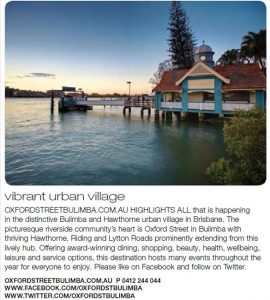
Oxford Street Bulimba, and beyond, exemplifies the potential of Brisbane’s urban village model – vibrant, walkable, and steeped in character, that extends across Bulimba, Hawthorne, Balmoral, and Morningside. Its tree-lined spine, heritage shopfronts, and curated mix of independent businesses create a memorable precinct that invites people to slow down, engage, and connect. Locals and visitors enjoy shaded pathways, boutique cafés, riverside green spaces, and laneways dotted with public art. From its ANZAC cottages to the 1922 ferry terminal, Oxford Street Bulimba reflects a layered past that infuses modern placemaking initiatives, like artisan markets and heritage trails, with cultural authenticity and community spirit.
Recent developments, such as the Lua precinct and transformation of the Bulimba Barracks, signal a confident shift toward mixed-use vitality. Rooftop wellness spaces, creative hubs, and adaptive reuse are deepening the precinct’s appeal while adding new functions to familiar streetscapes. The area remains a magnet for foot traffic, investment, and civic pride – an urban village with unmistakable soul.
Yet, like any thriving urban village, Oxford Street Bulimba, and beyond, faces challenges that come with success. Rising property values and prestige developments underscore concerns about affordability and displacement. Small businesses, essential to the street’s character, continue to navigate increasing lease and overheads costs, and competitive tenancy conditions. Retail vacancies and fast turnover can erode the continuity that fosters recognition, loyalty, and place identity. Infrastructure demands, particularly around parking, traffic flow, and transport integration, are intensifying and require agile responses. Likewise, maintaining architectural cohesion across new builds, preserving tree canopy, and ensuring inclusive access to housing and public spaces remain ongoing priorities.
Michael Gross, Managing Director of The National Property Research Co., has long advocated for urban villages like Oxford Street Bulimba, and beyond – not as static destinations, but as evolving, place-based ecosystems. His commentary reflects a consistent theme: urban villages thrive when they are contextually grounded, socially inclusive, and shaped by firsthand insights rather than detached data analysis. Gross champions walking the streets, talking to locals, and actively listening to community values. His advice resonates strongly in Bulimba, Hawthorne, Balmoral, and Morningside, where identity is shaped as much by conversation and culture, as it is by commercial activity.
From Gross’s perspective, an urban village like Oxford Street Bulimba is well-positioned, but must remain adaptive. He recommends continued investment in frontline research and stakeholder dialogue to stay attuned to buyer motivations, resident needs, and economic signals. Rather than focusing solely on supply-demand ratios, he urges urban village planners and developers to ask: What drives people to belong here? What makes them stay?
Gross also highlights the importance of aligning urban village development with transport access, employment hubs, and lifestyle infrastructure. In Oxford Street Bulimba’s case, the synergy between the ferry terminals, green corridors, and local commerce provides a strong foundation, but future growth must be anchored in holistic planning and community stewardship. He has been candid about developments that ignore post-construction market dynamics, warning that disconnecting profit from purpose can undermine long-term trust and value. For Oxford Street Bulimba, this serves as a timely reminder: prestige should never come at the expense of authenticity.
Above all, Gross calls for empathetic design – urban villages built not only for utility, but for connection, creativity, and inclusion. Oxford Street Bulimba, and beyond, offers precisely that spirit, but continued success hinges on managing density without sacrificing liveability, and attracting investment without losing character.
That balance is increasingly supported by Oxford Street Bulimba Marketing, which has championed place-based promotion since 2011. Through strategic digital campaigns, retail activation, and stakeholder engagement across Bulimba, Hawthorne, Balmoral, and Morningside, this local initiative sustains visibility, loyalty, and growth. By amplifying community stories, supporting independent businesses, nurturing stakeholder engagement and collaboration, and fostering a strong urban village identity, Oxford Street Bulimba Marketing reinforces the precinct’s role as a model for future urban villages – one that proudly blends heritage with innovation, and remains guided by place, planning, people, partnerships, possibility, and positivity.